Lista de correo. Espere su aprobación.
Correo electrónico:
Consultar este grupo

jueves, 7 de noviembre de 2013

Infecciones con Salmonella en laboratorio de microbiología universitario #LAI

On May 2, 2013, a case of salmonellosis was reported to the Maine Center for Disease Control and Prevention. The patient reported symptoms of diarrhea, fever, abdominal pain, and nausea, after attending a community college microbiology laboratory class. A second case was reported on May 8. Epidemiologic interviews conducted with both patients indicated common exposure at a community college, including one patient specifically naming the other patient.
On May 15, the Health and Environmental Testing Laboratory (HETL) determined that the clinical Salmonella isolates from stool specimens provided by outside hospital laboratories from both patients were indistinguishable by pulsed field gel electrophoresis (PFGE) analysis from a specimen used by the students during the microbiology class. The clinical isolates and laboratory class isolate all had a PFGE pattern indistinguishable from that of bacteria isolated during a national Salmonella Typhimurium outbreak in 2010 that was associated with clinical and teaching microbiology laboratories (1). No cases were reported from Maine during the 2010 outbreak. CONTINUA=>

lunes, 4 de noviembre de 2013

¡Los hospitales no se incendian!

¡Los hospitales no se incendian! Guía hospitalaria para la prevención de incendios y evacuación

Esta guía ha sido creada para poner de relieve la vulnerabilidad de los hospitales a los incendios. Es necesario que se adopten todas las medidas posibles para minimizar el riesgo de incendios en hospitales y asegurar la evacuación. El documento se puede aplicar en hospitales que han sido reforzados para mejorar la seguridad en cuanto a incendios, así como en nuevas instalaciones en proyecto.
El documento está dividido en cuatro secciones principales a considerarse en caso de incendio en hospitales, a saber, prevención, supresión, evacuación y simulacros de capacitación.
REFERENCIA:

lunes, 21 de octubre de 2013

Antimicrobial Resistance in the Food Chain: A Review

Overview of horizontal gene transfer in food products
(For complete image click HERE).
Antimicrobial resistant zoonotic pathogens present on food constitute a direct risk to public health. Antimicrobial resistance genes in commensal or pathogenic strains form an indirect risk to public health, as they increase the gene pool from which pathogenic bacteria can pick up resistance traits. Food can be contaminated with antimicrobial resistant bacteria and/or antimicrobial resistance genes in several ways. A first way is the presence of antibiotic resistant bacteria on food selected by the use of antibiotics during agricultural production. A second route is the possible presence of resistance genes in bacteria that are intentionally added during the processing of food (starter cultures, probiotics, bioconserving microorganisms and bacteriophages). A last way is through cross-contamination with antimicrobial resistant bacteria during food processing. Raw food products can be consumed without having undergone prior processing or preservation and therefore hold a substantial risk for transfer of antimicrobial resistance to humans, as the eventually present resistant bacteria are not killed. As a consequence, transfer of antimicrobial resistance genes between bacteria after ingestion by humans may occur. Under minimal processing or preservation treatment conditions, sublethally damaged or stressed cells can be maintained in the food, inducing antimicrobial resistance build-up and enhancing the risk of resistance transfer. Food processes that kill bacteria in food products, decrease the risk of transmission of antimicrobial resistance.
REFERENCIA:
Verraes C. Antimicrobial Resistance in the Food Chain: A Review. Int J Environ Res Public Health. 2013 July; 10(7): 2643–2669.

viernes, 18 de octubre de 2013

Influence of temperature and organic load on chemical disinfection

ABSTRACT:
This study evaluated the influence of temperature and organic load on the effectiveness of domestic bleach (DB), Surface Decontamination Foam (SDF), and Virkon in inactivating Geobacillus stearothermophilus spores, which are a surrogate for Bacillus anthracis spores. The spores were suspended in light or heavy organic preparations and the suspension was applied to stainless steel carrier disks. The dried spore inoculum was covered with the disinfectants and the disks were then incubated at various temperatures. At −20°C, the 3 disinfectants caused less than a 2.0 log10 reduction of spores in both organic preparations during a 24-h test period. At 4°C, the DB caused a 4.4 log10 reduction of spores in light organic preparations within 2 h, which was about 3 log10 higher than what was achieved with SDF or Virkon. In heavy organic preparations, after 24 h at 4°C the SDF had reduced the spore count by 4.5 log10, which was about 2 log10 higher than for DB or Virkon. In general, the disinfectants were most effective at 23°C but a 24-h contact time was required for SDF and Virkon to reduce spore counts in both organic preparations by at least 5.5 log10. Comparable disinfecting activity with DB only occurred with the light organic load. In summary, at temperatures as low as 4°C, DB was the most effective disinfectant, inactivating spores within 2 h on surfaces with a light organic load, whereas SDF produced the greatest reduction of spores within 24 h on surfaces with a heavy organic load.
REFERENCE:
Jiewen Guan, Maria Chan, Brian W. Brooks, and Liz Rohonczy. Influence of temperature and organic load on chemical disinfection of Geobacillus steareothermophilus spores, a surrogate for Bacillus anthracis. Can J Vet Res. 2013 April; 77(2): 100–104.

jueves, 17 de octubre de 2013

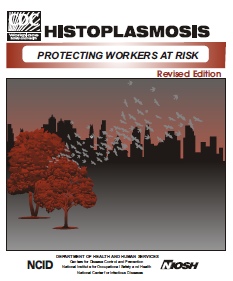
Histoplasmosis: Protecting Workers at Risk

This booklet is a revised edition of the NIOSH document Histoplasmosis: Protecting Workers at Risk, which was originally published in September 1997. The updated information in this booklet will help readers under­ stand what histoplasmosis is and recognize activities that may expose workers to the disease-causing fungus  Histoplasma capsulatum. The booklet also informs readers about methods they can use to protect themselves and others from exposure.
Outbreaks of histoplasmosis have shared similar circumstances: People who did not know the health risks of  breathing in the spores of H. capsulatum became ill and sometimes caused others nearby to become ill when they disturbed contaminated soil or accumulations of bird or bat manure. Because they were unaware of the hazard, they did not take protective measures that could have prevented illness.
This booklet will help prevent such exposures by serving as a guide for safety and health professionals, environmental consultants, supervisors, and others responsible for the safety and health of those working near material contaminated with H. capsulatum. Activities that pose a health risk to workers at these sites include disturbance of soil at an active or inactive bird roost or poultry house, excavation in regions where this  fungus is endemic, and removal of bat or bird manure from buildings.
REFERENCE:
Histoplasmosis: Protecting Workers at Risk. NIOSH/CDC 2003

miércoles, 16 de octubre de 2013

Technologies to Enable Autonomous Detection for BioWatch


Technologies to Enable Autonomous Detection for BioWatch is the summary of a workshop hosted jointly by the Institute of Medicine and the National Research Council in June 2013 to explore alternative cost-effective systems that would meet the requirements for a BioWatch Generation 3.0 autonomous detection system, or autonomous detector, for aerosolized agents . The workshop discussions and presentations focused on examination of the use of four classes of technologies--nucleic acid signatures, protein signatures, genomic sequencing, and mass spectrometry--that could reach Technology Readiness Level (TRL) 6-plus in which the technology has been validated and is ready to be tested in a relevant environment over three different tiers of temporal timeframes: those technologies that could be TRL 6-plus ready as part of an integrated system by 2016, those that are likely to be ready in the period 2016 to 2020, and those are not likely to be ready until after 2020. Technologies to Enable Autonomous Detection for BioWatch discusses the history of the BioWatch program, the role of public health officials and laboratorians in the interpretation of BioWatch data and the information that is needed from a system for effective decision making, and the current state of the art of four families of technology for the BioWatch program. This report explores how the technologies discussed might be strategically combined or deployed to optimize their contributions to an effective environmental detection capability.
Paperback
300 pages | 6 x 9 
ISBN 978-0-309-29251-1

lunes, 14 de octubre de 2013

Oct 15, Día Mundial del Lavado de Manos #IWashMyHands

Un gesto tan simple como lavarse las manos con agua y jabón puede ser clave para la supervivencia de millones de personas, sobre todo de los más pequeños. Los niños y niñas son especialmente vulnerables a los efectos de la diarrea y de las infecciones respiratorias, enfermedades que se pueden prevenir fácilmente y de forma barata con un poco de agua y jabón. Este día quiere servir como recordatorio de la importancia de esta práctica
El Día Mundial del Lavado de Manos es un llamamiento para concientizar a la población de que un poco de agua y jabón pueden salvar muchas vidas. Este día se celebra por primera vez este 15 de octubre en 70 países de los cinco contienentes. Es la primera vez en la historia en la que una campaña mundial pide a millones de personas que laven sus manos con agua y jabón
Referencias:
Global Hand Washing
UNICEF   

viernes, 11 de octubre de 2013

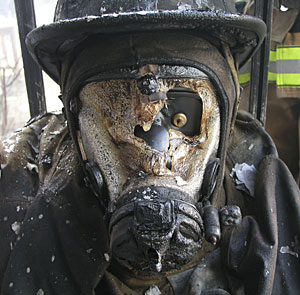
Fire Exposures of Fire Fighter Self-Contained Breathing Apparatus Facepiece Lenses

National Institute of Standards and Technology (NIST), conducted experiments which demonstrated a range of realistic thermal exposures and environmental conditions that firefighters could be exposed to. Self-contained breathing apparatus (SCBA) facepieces were exposed to thermal environments from propane-fueled calibration experiments and furnished townhouse fire experiments. The rooms and the facepieces were instrumented to measure temperatures of the environment and the facepieces. The fire experiments lasted 5 minutes to 10 minutes and produced ceiling temperatures of approximately 500 °C (932 °F) to 750 °C (1382 °F) in the room adjacent to the fire. A heat flux gauge was also installed next to the facepieces and measured peak heat fluxes from approximately 2 kW/m2 to 55 kW/m2. Eight facepieces were tested in six different experiments, with three facepiece lenses showing evidence of thermal degradation from the exposure. Maximum exterior lens temperatures were as high as 300 °C (572 °F) in these cases. The environments that caused the failures were identified in an attempt to characterize the thermal performance of SCBA facepieces. Although much was learned about conditions associated with thermal degradation of SCBA facepiece lenses, more experiments are needed to be able to understand the thermal degradation and more definitively predict the conditions that are likely to cause a facepiece lens failure.
REFERENCE
Fire Exposures of Fire Fighter Self-Contained Breathing Apparatus Facepiece Lenses
National Institute of Standards and Technology Technical Note 1724
Natl. Inst. Stand. Technol. Tech. Note 1724, 45 pages (November 2011)
CODEN: NSPUE2

jueves, 10 de octubre de 2013

The Handwashing Handbook

This handbook grows out of the experience of the Global Public-Private Partnership for Handwashing with Soap (PPPHW) and its predecessor, the Central American Handwashing for Diarrheal Disease Prevention Program. These efforts demonstrated that mass programs with public and private sector involvement can be successful in promoting handwashing and reducing disease. With core support from the Bank Netherlands Water Partnership, the PPPHW has brought together global public and private agencies to consolidate approaches while initiating large-scale handwashing promotion in Ghana, Peru, Senegal, and Nepal. While much has been learned about handwashing promotion in recent years, especially in the areas of research and program design, countries are still experimenting with, and optimizing approaches to implementation. It is important to lay out what is known so that others can begin designing programs and contributing to a global body of knowledge and experience in the fight against child mortality. This handbook is intended for staff in government and development organizations charged with carrying out handwashing programs. Decision-makers in Ministries and funding agencies will also find assistance in designing policies and programs to improve public health.

TheHandwashingHandbook:A guide for developing a hygiene promotion programto increase handwashing with soap

miércoles, 9 de octubre de 2013

Volcanoes: Protecting the Public´s Health

This instructional guide is meant for use before, during and after the viewing of the video "Volcanoes: Protecting the Public’s Health." It uses a simple format to present the most important aspects of the video, providing technical information for health personnel who may be involved in prevention, preparedness, or response activities in volcanic emergencies. The information in the video and guide are based on experiences in the Americas, addressing the major health risks associated with volcanic eruptions and basic planning measures that the health sector should undertake to reduce potential losses. The video is divided into two distinct but complementary sections that can be used together or separately.
REFERENCIA:
Volcanoes: Protecting the Public’s Health

lunes, 7 de octubre de 2013

Advancing infection control in dental care settings

ABSTRACT
Background and Overview. The authors set out to identify factors associated with implementation by U.S. dentists of four practices first recommended in the Centers for Disease Control and Prevention’s Guidelines for Infection Control in Dental Health-Care Settings—2003.
Methods. In 2008, the authors surveyed a stratified random sample of 6,825 U.S. dentists. The response rate was 49 percent. The authors gathered data regarding dentists’ demographic and practice characteristics, attitudes toward infection control, sources of instruction regarding the guidelines and knowledge about the need to use sterile water for surgical procedures. Then they assessed the impact of those factors on the implementation of four recommendations: having an infection control coordinator, maintaining dental unit water quality, documenting percutaneous injuries and using safer medical devices, such as safer syringes and scalpels. The authors conducted bivariate analyses and proportional odds modeling.
Results. Responding dentists in 34 percent of practices had implemented none or one of the four recommendations, 40 percent had implemented two of the recommendations and 26 percent had implemented three or four of the recommendations. The likelihood of implementation was higher among dentists who acknowledged the importance of infection control, had practiced dentistry for less than 30 years, had received more continuing dental education credits in infection control, correctly identified more surgical procedures that require the use of sterile water, worked in larger practices and had at least three sources of instruction regarding the guidelines. Dentists with practices in the South Atlantic, Middle Atlantic or East South Central U.S. Census divisions were less likely to have complied.
Conclusions. Implementation of the four recommendations varied among U.S. dentists. Strategies targeted at raising awareness of the importance of infection control, increasing continuing education requirements and developing multiple modes of instruction may increase implementation of current and future Centers for Disease Control and Prevention guidelines.
REFERENCE:
Jennifer L. Cleveland, et al.  Advancing infection control in dental care settings. JADA 2012;143(10):1127-1138.

viernes, 4 de octubre de 2013

StarTalkRadio: Zombie Apocalypse (Part 2)

PART 2: The Zombie Apocalypse rages on as Neil deGrasse Tyson hunts for the truth with World War Z author Max Brooks and Pulitzer Prize winning journalist and virus expert Laurie Garrett.
45 mins.


miércoles, 2 de octubre de 2013

How to choose a suit for a BSL4 laboratory

Elegir el traje apropiado para un laboratorio BSL4 es de vital importancia para crear un ambiente de trabajo seguir dentro de las instalaciones. El traje debe de proveer protección para quien lo usa y ser compatible con la infraestructura en las instalaciones, además de proporcionar cierto grado de confort. En este artículos los autores desarrollaron un programa de pruebas para comparar los diferentes modelos de traje y garantizar que los trajes elegidos puedan ser utilizados bajo condiciones específicas.
REFERENCIA:
Kümin D, Krebs C & Wick P. How to choose a suit for a BSL4 laboratory- The approach taken at Spiez Laboratory.  Applied Biosafety 2011. Vol. 16, No. 2, p94-102

lunes, 30 de septiembre de 2013

Intervención de laboratorios y bancos de sangre en situaciones de desastre

ISBN 92 75 32380 1
OPS/HSP/HSE/08-2001
Las situaciones de emergencia o desastre requieren de una respuesta rápida y oportuna por parte de los servicios de salud. Desde hace varios años, la Organización Panamericana de la Salud ha venido promoviendo el desarrollo de acciones para reducir la vulnerabilidad del sector salud y fortalecer los programas de preparativos ante emergencias y desastres.
Desastres recientes ocurridos en Centroamérica como los huracanes Mitch y George en 1998 o el terremoto de El Salvador en 2001, alertaron sobre la necesidad de integrar a los laboratorios de salud pública, laboratorios clínicos y bancos de sangre dentro de los planes de contingencia sectorial de salud, revelando tres áreas prioritarias de intervención:
• La confirmación diagnóstica de las enfermedades transmisibles de alta mortalidad.
• La disponibilidad de exámenes básicos para el manejo de heridos.
• La provisión oportuna de sangre segura.
La presente guía pretende sensibilizar y orientar a las autoridades de salud, directores y técnicos de laboratorios y bancos de sangre en la identificación de responsabilidades y funciones de estos servicios ante situaciones de desastres, basándose en prioridades, necesidades y capacidad de respuesta inmediata local. La incorporación de actividades de mitigación y reducción de vulnerabilidad, rehabilitación y reorganización de los servicios en los planes de contingencia permitirá una mejor respuesta de los servicios de salud posterior a los desastres.
REFERENCIA:
Intervención de laboratorios y bancos de sangre en situaciones de desastre

viernes, 27 de septiembre de 2013

StarTalkRadio: Zombie Apocalypse (Part 1)

PART 1: There’s no escaping the Zombie Apocalypse when Neil deGrasse Tyson interviews Max Brooks, author of World War Z and the world’s leading “authority” on these nonexistent killers.
45 mins.


miércoles, 25 de septiembre de 2013

Evaluation of the Operator Protection Factors Offered by Positive Pressure Air Suit

Laboratories throughout the world that perform work with Risk Group 4 Pathogens generally adopt one of two approaches within BSL-4 environments: either the use of positive pressure air-fed suits or using Class III microbiological safety cabinets and isolators for animal work. Within the UK at present, all laboratories working with Risk Group 4 agents adopt the use of Class III microbiological safety cabinet lines and isolators. Operator protection factors for the use of microbiological safety cabinets and isolators are available however; there is limited published data on the operator protection factors afforded by the use of positive pressure suits. This study evaluated the operator protection factors provided by positive pressure air suits against a realistic airborne microbiological challenge. The suits were tested, both intact and with their integrity compromised, on an animated mannequin within a stainless steel exposure chamber. The suits gave operator protection in all tests with an intact suit and with a cut in the leg. When compromised by a cut in the glove, a very small ingress of the challenge was seen as far as the wrist. This is likely to be due to the low airflow in the gloves of the suit. In all cases no microbiological penetration of the respiratory tract was observed. These data provide evidence on which to base safety protocols for use of positive pressure suits within high containment laboratorios.
REFERENCE
Viruses. 2012 August; 4(8): 1202–1211. PMCID: PMC3446757

lunes, 23 de septiembre de 2013

EMERGENCIAS: Prácticas Sanitarias para Jeringas Desechables

Vacunación
La mayoría de los programas de inmunización en las Américas usan jeringas desechables para poner vacunas. Durante desastres naturales, como el causado por el huracán Mitch, todo el personal de salud (voluntarios internacionales y personal nacional) deben asegurarse que las guías de la OPS/OMS se sigan, para garantizar el uso sanitario del equipo de inyección desechable y que el equipo apropiado esté disponible para recoger y eliminar las jeringas y agujas contaminadas. Esto aplica especialmente cuando los métodos normales de operación no pueden ser seguidos, ya sea porque la recolección de desechos médicos ha sido interrumpida, o porque las instalaciones donde deben ser destruidos de la manera apropiada no funcionan.

La OPS/OMS recomienda las normas siguientes:

  • Las jeringas "autodestructibles" [a] son el tipo preferido de inyecciones desechables con el que se aplican vacunas y el material escogido para llevar a cabo campañas de inmunizaciones en gran cantidad de gente.
  • Los trabajadores de la salud no deben rehusar las agujas.
  • Las jeringas desechables usadas deben recolectarse en "Cajas de Seguridad", que son contenedores resistentes a perforaciones, diseñados para colectar equipo de inyecciones.
  • Las "Cajas de Seguridad" o contenedores similares donde se recolectan equipo de inoculación contaminado, debe ser transportado con mucho cuidado a un sitio de incineración.
  • Si no existen o no están en servicio las instalaciones o sitios para incineración, las "Cajas de Seguridad" se pueden quemar en una fosa o algo parecido, por ejemplo un barril metálico. Las agujas quemadas se pueden enterrar de una manera segura o eliminadas con otra basura.
  • No cumplir con estas normas puede poner en riesgo la salud pública ya que el material de inoculación podría ser utilizado de nuevo exponiendo a la gente a enfermedades y a la muerte.
  • Los trabajadores de la salud que rehusan agujas se arriesgan a contraer enfermedades infecciosas debido a pinchazos accidentales. El público podría pincharse accidentalmente si las agujas y jeringas no son destruidas de una manera apropiada.

Recuerde: toda inyección debe administrarse con una aguja y jeringa estéril.

a. Jeringas autodestructibles son jeringas desechables que contienen un mecanismo por el cual automáticamente no pueden ser rehusadas después de la primera vez.

REFERENCIA:
http://www.paho.org/disasters/index.php?option=com_content&task=view&id=555&Itemid=664

viernes, 20 de septiembre de 2013

VIDEO: Problemas sanitarios durante el terremoto en México - 1985

Esta producción describe los problemas sanitarios y las actividades de socorro realizadas a raíz de los terremotos del 19 y 20 de septiembre de 1985 en México. El primer sismo, de magnitud 8,1 en la escala de Richer, dejó más de 10.000 muertos o desaparecidos y miles de heridos.

miércoles, 18 de septiembre de 2013

Efficacy of disinfectants against naturally occurring and artificially cultivated bacteria.

Abstract
Naturally occurring bacteria, is exist in nature, and is never cultivated on conventional culture medium. We evaluated the efficacy of disinfectants against naturally occurring bacteria in in-use cotton balls soaked in 0.02% benzalkonium chloride solution which had been used to disinfect the genital area by patients undergoing self-catheterization at home and the same bacteria subcultured on nutrient broth (artificially cultivated bacteria). The colony forming units (CFU) of naturally occurring bacteria such as Serratia marcescens, Alcaligenes xylosoxidans, and Burkholderia cepacia were not decreased after 48 h exposure to 0.025-0.1% benzalkonium chloride solution, but the same strains subcultured on nutrient broth were killed within only 10 min exposure to 0.025-0.1% benzalkonium chloride solution. In addition, the CFU of these three kinds of naturally occurring bacteria were not decreased after 48 h exposure to 0.02% chlorhexidine gluconate solution, but the same strains subcultured on nutrient broth were killed within 2 h exposure to chlorhexidine gluconate solution. The result showed that disinfectant efficacy differed markedly against naturally occurring and artificially cultivated bacteria. Therefore, it is preferable to use the naturally occurring bacteria not only artificially cultivated bacteria when examining disinfectant efficacy.

REFERENCE:
Suwa M, Oie S, Furukawa H. Efficacy of disinfectants against naturally occurring and artificially cultivated bacteria. Biol Pharm Bull. 2013;36(3):360-3. PubMed PMID: 23449324.

martes, 17 de septiembre de 2013

Communicable disease control in emergencies - A field manual

 
Publication details
Pages: 301
Pub. date: 2005
Language : English
ISBN  924154616 6
Download English
This manual is intended to help health professionals and public health coordinators working in emergency situations prevent, detect and control the major communicable diseases encountered by affected populations. Emergencies include complex emergencies and natural disasters (e.g. floods and earthquakes). The term “complex emergencies” has been coined to describe “situations of war or civil strife affecting large civilian populations with food shortages and population displacement, resulting in excess mortality and morbidity”.
In this manual, the generic term “emergencies” will be used to encompass all situations in which large populations are in need of urgent humanitarian relief. Following an emergency, the affected population is often displaced and temporarily resettled. They may be placed in camps or become dispersed among the local population (either in towns or in rural communities). People who are displaced across national borders are termed refugees whereas those who have been displaced within their country are called “internally displaced persons” (IDPs). Resettlement in camps may entail high population densities, inadequate shelter, poor water supplies and sanitation, and a lack of even basic health care. In these situations, there is an increased threat of communicable disease and a high risk of epidemics.

lunes, 16 de septiembre de 2013

Sanitizer Efficacy against Murine Norovirus on Stainless Steel Surfaces

Abstract
Human noroviruses are major etiologic agents of epidemic gastroenteritis. Outbreaks are often accompanied by contamination of environmental surfaces, but since these viruses cannot be routinely propagated in laboratory cultures, their response to surface disinfectants is predicted by using surrogates, such as murine norovirus 1 (MNV-1). This study compared the virucidal efficacies of various liquid treatments (three sanitizer liquids, 5% levulinic acid plus 2% SDS [LEV/SDS], 200 ppm chlorine, and an isopropanol-based quaternary ammonium compound [Alpet D2], and two control liquids, sterile tap water and sterile tap water plus 2% SDS) when delivered to MNV-1-inoculated stainless steel surfaces by conventional hydraulic or air-assisted, induction-charged (AAIC) electrostatic spraying or by wiping with impregnated towelettes. For the spray treatments, LEV/SDS proved effective when applied with hydraulic and AAIC electrostatic spraying, providing virus reductions of 2.71 and 1.66 log PFU/ml, respectively. Alpet D2 provided a 2.23-log PFU/ml reduction with hydraulic spraying, outperforming chlorine (1.16-log PFU/ml reduction). Chlorine and LEV/SDS were equally effective as wipes, reducing the viral load by 7.05 log PFU/ml. Controls reduced the viral load by <1 log with spraying applications and by >3 log PFU/ml with wiping. Results indicated that both sanitizer type and application methods should be carefully considered when choosing a surface disinfectant to best prevent and control environmental contamination by noroviruses.
REFERENCE:
Bolton SL, Kotwal G, Harrison MA, Law SE, Harrison JA, Cannon JL. Sanitizerefficacy against murine norovirus, a surrogate for human norovirus, on stainless steel surfaces when using three application methods. Appl Environ Microbiol. 2013
Feb;79(4):1368-77. doi: 10.1128/AEM.02843-12. Epub 2012 Dec 21. PubMed PMID:
23263949; PubMed Central PMCID: PMC3568589.

viernes, 13 de septiembre de 2013

WHO: Emergency Response Framework

Download
WHO’s Member States face a broad range of emergencies resulting from various hazards and differing in scale, complexity and international consequences. These  emergencies can have extensive political, economic, social and public health impacts,  with potential long-term consequences sometimes persisting for years after the  emergency. They may be caused by natural disasters, conflict, disease outbreaks, food contamination, or chemical or radio-nuclear spills, among other hazards. They can undermine decades of social development and hard-earned health gains, damage hospitals and other health infrastructure, weaken health systems and slow progress towards the Millennium Development Goals (MDGs). Preparing for and responding effectively to such emergencies are among the most pressing challenges facing the international community.

REFERENCE:
WHO: Emergency Response Framework. ISBN 978 92 4 150497 3

miércoles, 11 de septiembre de 2013

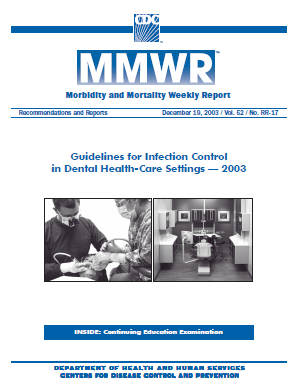
Guidelines for Infection Control in Dental Health-Care Settings

This report consolidates previous recommendations and adds new ones for infection control in dental settings. Recommendations are provided regarding 1) educating and protecting dental health-care personnel; 2) preventing transmission of bloodborne pathogens; 3) hand hygiene; 4) personal protective equipment; 5) contact dermatitis and latex hypersensitivity; 6) sterilization and disinfection of patient-care items; 7) environmental infection control; 8) dental unit waterlines, biofilm, and water quality; and 9) special considerations (e.g., dental handpieces and other devices, radiology, parenteral medications, oral surgical procedures, and dental laboratories). These recommendations were developed in collaboration with and after review by authorities on infection control from CDC and other public agencies, academia, and private and professional organizations.
REFERENCE:
Guidelines for Infection Control in Dental Health-Care Settings, 2003. MMWR, December 19, 2003:52(RR-17).
Puede también descargarlo AQUI

Recommendations on the Transport of Dangerous Goods, Model Regulation. Book UNECE 2013

Published:July 2013
ST/SG/AC.10/1/Rev.18

Complete set of two volumes
Sales No. 13.VIII.1
ISBN 978-92-1-139146-6
Price: US$ 155
Languages: E, F
(A, C, R forthcoming)
UNECE.ORG
These recommendations have been developed in the light of technical progress, the advent of new substances and materials, the exigencies of modern transport systems and, above all, the requirement to ensure the safety of people, property and the environment. They are addressed to governments and international organisations concerned with the regulation of the transport of dangerous goods. The Model Regulations cover the classification of dangerous goods, their listing, the use, construction, testing and approval of packagings and portable tanks, as well as consignment procedures such as marking, labelling, placarding and documentation.
This eighteenth revised edition contains various new and revised provisions concerning, inter alia, classification of solid oxidizing substances; transport of adsorbed gases; lithium batteries (including damaged or defective lithium batteries, lithium batteries for disposal or recycling); asymmetric capacitors; discarded packagings; ammonium nitrate and radioactive material; testing of gas cartridges and fuel cell cartridges; marking of bundles of cylinders; and the applicability of ISO standards to the manufacture of new pressure receptacles or service equipment.
UNECE: United Nations Economic Commision for Europe
Versión 2009 en Español

lunes, 9 de septiembre de 2013

Emergency First Responder Respirator Thermal Characteristics: Workshop Proceedings

The purpose of this workshop was to identify performance needs and establish research priorities to address the thermal characteristics of respiratory equipment used by emergency first responders. The workshop provided a forum for representatives from the first responder community, self contained breathing apparatus (SCBA) and component manufacturers, and research and testing experts to discuss issues, technologies, and research associated with SCBA high temperature performance. The goals of the workshop were defined in two parts: 1) Clarify baseline information, including the current state-of-the-art, applicable fire service events, and current related research, and 2) Research planning, including identification of performance needs and short and long term research priorities. Presentations were given to explain the current SCBA and certification process, understand experience from actual fire service incidents, and review the current state of respirator research. After the presentations, the workshop divided into three working group sessions to discuss performance needs and research priorities in smaller groups. Suggested topics for discussion included: a) Current Equipment, b) Current Practice and Usage, c) Future Trends, d) Short Term Research Needs, e) Long Term Research Needs, and f) other issues. The results of the three smaller groups’ deliberations were discussed when the full workshop reconvened. The responses from each group were merged into a combination of issues that related to the use and performance of the lens of the SCBA. The primary concerns and research priorities were the characterization of the fire fighter environment, performance of current and new technology, development of representative and realistic testing, and improvements to fire fighter training on the limitations of protective equipment. A significant amount of discussion concentrated on the testing for NFPA certification, which currently contains limited thermal testing.
REFERENCE
NIOSH Emergency First Responder Respirator  Thermal Characteristics: Workshop Proceedings
National Institute of Standards and Technology Special Publication 1123
Natl. Inst. Stand. Technol. Spec. Publ. 1123, 52 pages (June 2011)