Lista de correo. Espere su aprobación.
Correo electrónico:
Consultar este grupo
Mostrando las entradas con la etiqueta Ambiente. Mostrar todas las entradas

lunes, 13 de octubre de 2014

Día Mundial del Lavado de Manos, Octubre 15

Este 15 de Octubre, la Organización Mundial de la Salud, en conjunto con la UNICEF celebran el Día Mundial del Lavado de Manos. Esta es una oportunidad para recordar a todos la importancia del Lavado de Manos. Infórmate y distribuye la información acerca de la importancia del lavado de manos en: http://globalhandwashing.org
Descarga los posters y manuales de la campaña de la UNICEF AQUI.

OTROS MATERIALES Y RECURSOS (INGLÉS)
This course and promotional materials review key concepts of hand hygiene and other standard precautions to prevent healthcare-associated infections.
Promotional materials (Posters).
A variety of resources including guidelines for providers, patient empowerment materials, the latest technological advances in hand hygiene adherence measurement, frequently asked questions, and links to promotional and educational tools.
All health-care workers require clear and comprehensive training and education on the importance of hand hygiene, the "My 5 Moments for Hand Hygiene" approach and the correct procedures for handrubbing and handwashing.
Hygiene refers to behaviors that can improve cleanliness and lead to good health, such as frequent hand washing, face washing, and bathing with soap and water. In many areas of the world, practicing personal hygiene etiquette is difficult due to lack of clean water and soap. Many diseases can be spread if the hands, face, or body are not washed appropriately at key times.

--------------------------------------------
Sigue este Blog en Facebook y Twitter

jueves, 25 de septiembre de 2014

Addressing climate change in healthcare settings

Publication details
Number of pages: 28
Publication date: 2009
Languages: English
Global climate change is no longer an ominous future threat but a dawning reality – one that is already creating disturbing shifts in the natural and human environment and eroding the delicate balance of our planet’s ecosystem and the species that depend on it.
This discussion draft is based on the World Health Organization’s (WHO) mandate from member states to develop “programmes for health systems that will contribute to reducing their own greenhouse gas emissions”. It also takes root in Health Care Without Harm’s (HCWH) more than 12 years of experience of working globally to transform the health sector so that it is no longer a source of harm to human health and the environment.
The paper begins to define a framework for analysing and addressing the health sector’s climate footprint – including identifying seven aspects of a climate-friendly hospital. It also draws on a series of examples from around the world that demonstrate that the health sector is indeed already beginning to provide leadership in this most important area of concern to the global community. This paper is the first step in a WHO project in collaboration with Health Care Without Harm (HCWH) aimed at addressing the climate footprint of the health sector.
REFERENCE:
World Health Organization and Health Care Without Harm. Healthy hospitals, healthy planet, healthy people: Addressing climate change in healthcare settings, 2009.
------------------------------------------------
Sigue este Blog en Facebook y Twitter

jueves, 7 de agosto de 2014

Evaluation of transmission risks associated with in vivo replication of several high containment pathogens in a biosafety level 4 laboratory #EBOLA

Containment level 4 (CL4) laboratories studying biosafety level 4 viruses are under strict regulations to conduct nonhuman primate (NHP) studies in compliance of both animal welfare and biosafety requirements. NHPs housed in open-barred cages raise concerns about cross-contamination between animals, and accidental exposure of personnel to infectious materials. To address these concerns, two NHP experiments were performed. One examined the simultaneous infection of 6 groups of NHPs with 6 different viruses (Machupo, Junin, Rift Valley Fever, Crimean-Congo Hemorrhagic Fever, Nipah and Hendra viruses). Washing personnel between handling each NHP group, floor to ceiling biobubble with HEPA filter, and plexiglass between cages were employed for partial primary containment. The second experiment employed no primary containment around open barred cages with Ebola virus infected NHPs 0.3 meters from naïve NHPs. Viral antigen-specific ELISAs, qRT-PCR and TCID50 infectious assays were utilized to determine antibody levels and viral loads. No transmission of virus to neighbouring NHPs was observed suggesting limited containment protocols are sufficient for multi-viral CL4 experiments within one room. The results support the concept that Ebola virus infection is self-contained in NHPs infected intramuscularly, at least in the present experimental conditions, and is not transmitted to naïve NHPs via an airborne route.

REFERENCE:
Alimonti J, et al. Evaluation of transmission risks associated with in vivo replication of several high containment pathogens in a biosafety level 4 laboratory. Scientific Reports 4, Article number: 5824.
-----------------------------------------------------------
Sigue este Blog en Facebook y Twitter

lunes, 20 de enero de 2014

ABSL-4 Aerobiology Biosafety and Technology...

Abstract
The overall threat of a viral pathogen to human populations is largely determined by the modus operandi and velocity of the pathogen that is transmitted among humans. Microorganisms that can spread by aerosol are considered a more challenging enemy than those that require direct body-to-body contact for transmission, due to the potential for infection of numerous people rather than a single individual. Additionally, disease containment is much more difficult to achieve for aerosolized viral pathogens than for pathogens that spread solely via direct person-to-person contact. Thus, aerobiology has become an increasingly necessary component for studying viral pathogens that are naturally or intentionally transmitted by aerosol. The goal of studying aerosol viral pathogens is to improve public health preparedness and medical countermeasure development. Here, we provide a brief overview of the animal biosafety level 4 Aerobiology Core at the NIH/NIAID Integrated Research Facility at Fort Detrick, Maryland, USA.
REFERENCE:
Lackemeyer MG, Kok-Mercado Fd, Wada J, Bollinger L, Kindrachuk J, Wahl-Jensen V, Kuhn JH, Jahrling PB. ABSL-4 Aerobiology Biosafety and Technology at the NIH/NIAID Integrated Research Facility at Fort Detrick. Viruses. 2014 Jan 7;6(1):137-50. doi: 10.3390/v6010137. PubMed PMID: 24402304.

jueves, 7 de noviembre de 2013

Infecciones con Salmonella en laboratorio de microbiología universitario #LAI

On May 2, 2013, a case of salmonellosis was reported to the Maine Center for Disease Control and Prevention. The patient reported symptoms of diarrhea, fever, abdominal pain, and nausea, after attending a community college microbiology laboratory class. A second case was reported on May 8. Epidemiologic interviews conducted with both patients indicated common exposure at a community college, including one patient specifically naming the other patient.
On May 15, the Health and Environmental Testing Laboratory (HETL) determined that the clinical Salmonella isolates from stool specimens provided by outside hospital laboratories from both patients were indistinguishable by pulsed field gel electrophoresis (PFGE) analysis from a specimen used by the students during the microbiology class. The clinical isolates and laboratory class isolate all had a PFGE pattern indistinguishable from that of bacteria isolated during a national Salmonella Typhimurium outbreak in 2010 that was associated with clinical and teaching microbiology laboratories (1). No cases were reported from Maine during the 2010 outbreak. CONTINUA=>

viernes, 11 de octubre de 2013

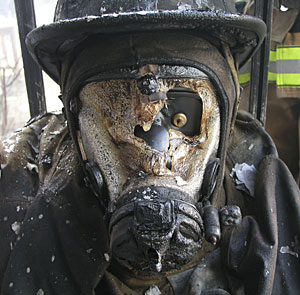
Fire Exposures of Fire Fighter Self-Contained Breathing Apparatus Facepiece Lenses

National Institute of Standards and Technology (NIST), conducted experiments which demonstrated a range of realistic thermal exposures and environmental conditions that firefighters could be exposed to. Self-contained breathing apparatus (SCBA) facepieces were exposed to thermal environments from propane-fueled calibration experiments and furnished townhouse fire experiments. The rooms and the facepieces were instrumented to measure temperatures of the environment and the facepieces. The fire experiments lasted 5 minutes to 10 minutes and produced ceiling temperatures of approximately 500 °C (932 °F) to 750 °C (1382 °F) in the room adjacent to the fire. A heat flux gauge was also installed next to the facepieces and measured peak heat fluxes from approximately 2 kW/m2 to 55 kW/m2. Eight facepieces were tested in six different experiments, with three facepiece lenses showing evidence of thermal degradation from the exposure. Maximum exterior lens temperatures were as high as 300 °C (572 °F) in these cases. The environments that caused the failures were identified in an attempt to characterize the thermal performance of SCBA facepieces. Although much was learned about conditions associated with thermal degradation of SCBA facepiece lenses, more experiments are needed to be able to understand the thermal degradation and more definitively predict the conditions that are likely to cause a facepiece lens failure.
REFERENCE
Fire Exposures of Fire Fighter Self-Contained Breathing Apparatus Facepiece Lenses
National Institute of Standards and Technology Technical Note 1724
Natl. Inst. Stand. Technol. Tech. Note 1724, 45 pages (November 2011)
CODEN: NSPUE2

miércoles, 9 de octubre de 2013

Volcanoes: Protecting the Public´s Health

This instructional guide is meant for use before, during and after the viewing of the video "Volcanoes: Protecting the Public’s Health." It uses a simple format to present the most important aspects of the video, providing technical information for health personnel who may be involved in prevention, preparedness, or response activities in volcanic emergencies. The information in the video and guide are based on experiences in the Americas, addressing the major health risks associated with volcanic eruptions and basic planning measures that the health sector should undertake to reduce potential losses. The video is divided into two distinct but complementary sections that can be used together or separately.
REFERENCIA:
Volcanoes: Protecting the Public’s Health

lunes, 9 de septiembre de 2013

Emergency First Responder Respirator Thermal Characteristics: Workshop Proceedings

The purpose of this workshop was to identify performance needs and establish research priorities to address the thermal characteristics of respiratory equipment used by emergency first responders. The workshop provided a forum for representatives from the first responder community, self contained breathing apparatus (SCBA) and component manufacturers, and research and testing experts to discuss issues, technologies, and research associated with SCBA high temperature performance. The goals of the workshop were defined in two parts: 1) Clarify baseline information, including the current state-of-the-art, applicable fire service events, and current related research, and 2) Research planning, including identification of performance needs and short and long term research priorities. Presentations were given to explain the current SCBA and certification process, understand experience from actual fire service incidents, and review the current state of respirator research. After the presentations, the workshop divided into three working group sessions to discuss performance needs and research priorities in smaller groups. Suggested topics for discussion included: a) Current Equipment, b) Current Practice and Usage, c) Future Trends, d) Short Term Research Needs, e) Long Term Research Needs, and f) other issues. The results of the three smaller groups’ deliberations were discussed when the full workshop reconvened. The responses from each group were merged into a combination of issues that related to the use and performance of the lens of the SCBA. The primary concerns and research priorities were the characterization of the fire fighter environment, performance of current and new technology, development of representative and realistic testing, and improvements to fire fighter training on the limitations of protective equipment. A significant amount of discussion concentrated on the testing for NFPA certification, which currently contains limited thermal testing.
REFERENCE
NIOSH Emergency First Responder Respirator  Thermal Characteristics: Workshop Proceedings
National Institute of Standards and Technology Special Publication 1123
Natl. Inst. Stand. Technol. Spec. Publ. 1123, 52 pages (June 2011)

jueves, 16 de mayo de 2013

#Popocatépetl: Riesgos de la ceniza volcánica

Popocatépetl, Mayo 16, 2013
Las recientes erupciones del volcán Popocatépetl nos hacen recordar los riesgos de la inhalación de la ceniza volcánica. La ceniza volcánica es roca pulverizada, minerales y vidrio volcánico de tamaño menor a 2 mm, aunque en muchas ocasiones se incluye a partículas de mayor tamaño. La ceniza se forma durante los procesos explosivos de los volcanes y que son lanzados de forma violenta a la atmósfera, generalmente acompañado de gases tóxicos y rocas. La ceniza volcánica es extremadamente abrasiva y no se disuelve en agua. Debido a su pequeño tamaño y la gran altura que alcanzan durante las explosiones, estas puedes dispersarse a muchos kilómetros a la redonda de los volcanes.
Popocatépetl, Mayo 16, 2013
Entre los riesgos principales de estas partículas se encuentran:
  1. Contaminación de fuentes de agua.
  2. Alteración de las fuentes de suministro eléctrico.
  3. Daño a componentes mecánicos y eléctricos de aviones.
  4. Afectaciones a las vías de comunicación terrestre.
  5. Alteraciones a las comunicaciones.
  6. Afectaciones a estructuras de casas y edificios. 
  7. Afectaciones ambientales y la agricultura.
  8. Afectación a la salud humana y animal.
Ceniza volcánica
En este último punto es muy importante mencionar que todas aquellas partículas de un tamaño menor a 10 micras de diámetro son inhalables y que se pueden depositar en los pulmones, causando síntomas respiratorios de severos a graves, especialmente dificultad para respirar. Pero además pueden causar enfermedades crónicas y cáncer, por inhalación de sílica cristalina (silicosis). Estudios han revelado que el 25% de las partículas que son expulsadas por los volcanes, son menores a 10 micras.
La mejor protección contra la ceniza volcánica son las mascarillas N95 ó N100, ya que son desechables, ligeras y de alta eficiencia de filtración.

Ceniza volcánica.
REFERENCIAS:
    1. Horwell CJ & Baxter PJ. The respiratory health hazards of volcanic ash: a review for volcanic risk mitigation. Bull Volcanol 2006; DOI 10.1007/s00445-006-0052-y
    2. El tamaño de las partículas.
    3. Máscaras protectoras de polvo para protegerse de las cenizas volcánicas
    4. Semáforo de alerta volcánica 
    5. CENAPRED.
    6. #Popocatépetl: Protección respiratoria contra la ceniza volcánica 
    7. ¿Mascarillas o respiradores? ¿Que debo usar?
    8. Durante la erupción del volcán
      Merapi en Bali, Indonesia
    9. Many types of hazards are associated with volcanoes 
    10. Las personas con enfermedades respiratorias son más vulnerables a los efectos de la ceniza, informa la OMS


    Microfotografía de una
    partícula volcánica
    Acciones de limpieza de ceniza,
    volcán Tungurahua, Ecuador.
    Durante la erupción del volcán
    Merapi en Bali, Indonesia.


    Durante la erupción del volcán
    Eyjafjallajökull en Islandia


    Mascarilla N95


    Durante la erupción del volcán
    Merapi en Bali, Indonesia