|
| Photo: Mashable |
REFERENCE:
Kelle A. Synthetic biology and biosecurity. From low levels of awareness to a comprehensive strategy. EMBO Rep. 2009 Aug;10 Suppl 1:S23-7.

|
| Photo: Mashable |

1: Merler S, Ajelli M, Fumanelli L, Vespignani A. Containing the accidental laboratory escape of potential pandemic influenza viruses. BMC Med. 2013 Nov
28;11:252

ABSTRACT
Background: Healthcare workers may come into contact with fomites containing
infectious HCV during preparation of plasma, or following placement or removal of
venous lines. Similarly, injection drugs users may come into contact with fomites.
Hypothesizing that prolonged viability of HCV in fomites may contribute significantly to
incidence; we determined the longevity of virus infectivity and the effectiveness of
antiseptics.
Methods: We determined the volume of drops misplaced during transfer of serum or
plasma. Aliquots equivalent to the maximum drop volume of plasma spiked with 2a
HCV reporter virus were loaded into 24-well plates. Plates were stored uncovered at three
temperatures: 4°, 22°, and 37°C for up to 6 weeks before viral infectivity was determined
in a microculture assay.
Results: The mean volume of an accidental drop was 29 μl (min - max of 20 - 33 μl). At
storage temperatures 4° and 22°C, we recovered viable HCV from the low titer spots for
up to 6 weeks of storage. The rank order of HCV virucidal activity of commonly used
antiseptics was bleach (1:10) > cavicide (1:10) > ethanol (70%).
Conclusions:
The hypothesis of potential transmission from fomites was supported by the experimental
results. The anti-HCV activity of commercial antiseptics varied.
Reference
Elijah Paintsil1, Mawuena Binka2, Amisha Patel2, Brett D. Lindenbach3, and Robert Heimer2. Hepatitis C Virus Maintains Infectivity for Weeks after Drying on Inanimate Surfaces at Room Temperature: Implications for Risks of Transmission. JID 2013.
http://jid.oxfordjournals.org/content/early/2013/11/22/infdis.jit648.full.pdf
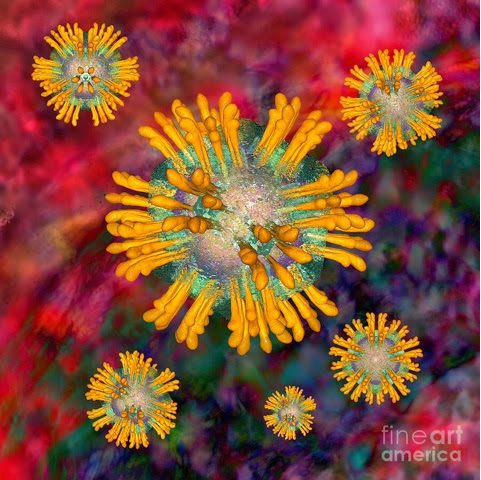

Responsible life sciences research for global health security #DURC
Publication date: 2010
Languages: English
WHO reference number: WHO/HSE/GAR/BDP/2010.2


 | |||||||||
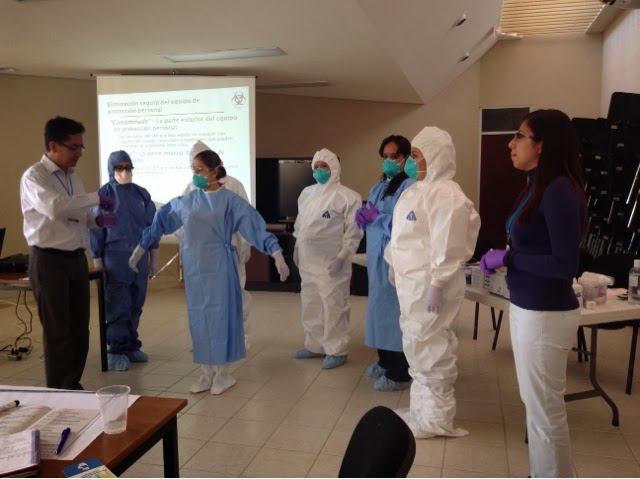

¡Los hospitales no se incendian! Guía hospitalaria para la prevención de incendios y evacuación
Esta guía ha sido creada para poner de relieve la vulnerabilidad de los hospitales a los incendios. Es necesario que se adopten todas las medidas posibles para minimizar el riesgo de incendios en hospitales y asegurar la evacuación. El documento se puede aplicar en hospitales que han sido reforzados para mejorar la seguridad en cuanto a incendios, así como en nuevas instalaciones en proyecto.
El documento está dividido en cuatro secciones principales a considerarse en caso de incendio en hospitales, a saber, prevención, supresión, evacuación y simulacros de capacitación.
REFERENCIA:
|
 |
| Overview of horizontal gene transfer in food products (For complete image click HERE). |