Lista de correo. Espere su aprobación.
Correo electrónico:
Consultar este grupo

miércoles, 20 de julio de 2016

Hipoclorito de sodio como agente desinfectante

Este artículo es sobre soluciones desinfectantes, siga el link para ver: 

Publicado originalmente el 19 de Julio de 2008. 

Actualizado 03/feb/2025

El hipoclorito de sodio (NaOCl) es un compuesto oxidante de rápida acción utilizado a gran escala para la desinfección de superficies, desinfección de ropa hospitalaria y desechos, descontaminar salpicaduras de sangre, desinfección de equipos y mesas de trabajo resistentes a la oxidación, eliminación de olores y desinfección del agua. Los equipos o muebles metálicos tratados con cloro, tienden a oxidarse rápidamente en presencia de hipoclorito de sodio.
El hipoclorito de sodio es vendido en una solución clara de ligero color verde-amarillento y un olor característico. Como agente blanqueante de uso domestico normalmente contiene 5-6.5% de hipoclorito de sodio (con un pH de alrededor de 11, es irritante y corrosivo a los metales). Cuando el hipoclorito se conserva en su contenedor a temperatura ambiente y sin abrirlo, puede conservarse durante 1 mes, pero cuando se ha utilizado para preparar soluciones, se recomienda  su cambio diario. Entre sus muchas propiedades incluyen su amplia y rápida actividad antimicrobiana, relativa estabilidad, fácil uso y bajo costo.
El hipoclorito es letal para varios microorganismos, virus y bacterias vegetativas, pero es menos efectivo contra esporas bacterianas, hongos y protozoarios. La actividad del hipoclorito se ve reducida en presencia de iones metálicos, biocapas, materiales orgánicos, bajo pH o luz UV. Las soluciones de trabajo deben ser preparadas diariamente. El cloro comercial que contiene 5-6%, que será utilizado para la desinfección de superficies, debe ser diluído 1:10 para obtener una concentración final de aproximadamente 0.5% de hipoclorito. Cuando se quiere desinfectar líquidos que pueden contener material orgánico, debe tenerse una concentración final de 1% de hipoclorito.
Gracias a su alta disponibilidad continua siendo de alto uso en hospitales. Pueden encontrar otras características y hojas de seguridad del hipoclorito de sodio. 
El modo de acción del hipoclorito es la oxidación: oxida proteínas, oxida DNA y RNA, oxida grasas, oxida metales.. OXIDA!, OXIDA!, OXIDA!, OXIDA!, OXIDA!... 


#VIDEOBLOG:


------------------------------------------------------------------------

CONCENTRACIONES RECOMENDADAS
  • Venta al público: (Blanqueador casero, presentación comercial): 5-6 % (50-60 g/l, 50,000 ppm) de cloro libre
  • Para desinfección con material orgánico o derrames:  1% (10 g/l, 10,000 ppm)
  • Para desinfección general de áreas sin materia orgánica:  0.5% (5g/L;  5,000 ppm)
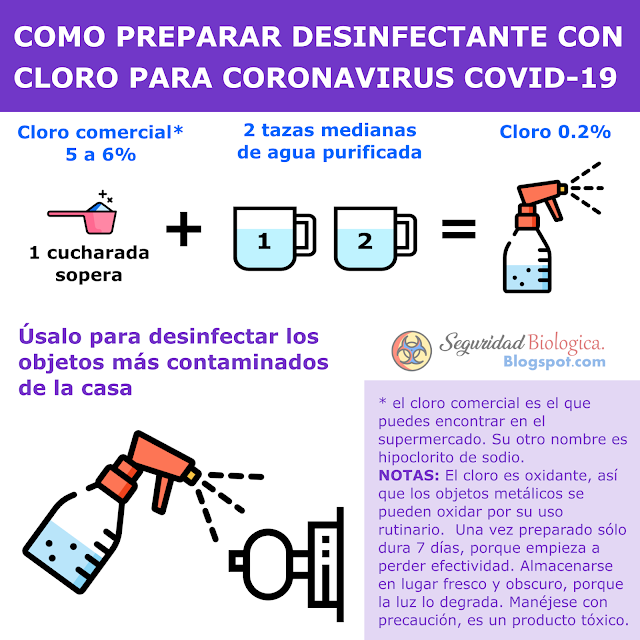
  • Para desinfección de superficies (CORONAVIRUS):  0.2%
  • Para limpieza general, desinfección de manos, desinfección de ropa: 0.05% (500 mg/L; 500 ppm) *
-----------------------------------------------------------------------

RECOMENDACIONES PARA LA PREPARACIÓN Y USO:
  1. Antes de elegir un agente desinfectante, por favor revisa su efectividad para el microorganismo que te interesa.
  2. USAR agua destilada o desinizada. El agua de la llave contiene muchos metales y sales que interfieren con su efectividad.
  3. Revisar la etiqueta antes de preparar el hipoclorito de sodio buscando la caducidad y la concentración de venta. 
  4. Existen dos tipos de hipoclorito de sodio. El regular, que tiene una caducidad de 2 a 3 meses, y el "estabilizado", que tiene una caducidad de 1 a 2 años. Pero ambos se degradan rápidamente una vez preparados, por lo que no deben utilizarse después de 5 días de su preparación. 
  5. Almacenar en un lugar fresco, seco y obscuro, ya que la luz y el calor aceleran su degradación.
  6. Existen varios procedimientos para la desinfección, por ejemplo LAVADO => DESINFECCIÓN => ENJUAGUE, es decir, realizar un lavado antes de la desinfección para retirar materia orgánica, luego aplicar el desinfectante, y realizar enjuagado para eliminar el exceso de desinfectate. 
  7. Para la desinfección de líquidos que puedan contener microorganismos, debe prepararse una solución al 2% de hipoclorito de sodio. Posteriormente, mezclar en proporción 1:1 (1 volumen de desinfectante, 1 volumen de líquido). De esta forma, al final tendrá una concentración de 1%. Dejar reposar durante 30 minutos. Por ejemplo: 200 ml de orina + 200 ml de solución de hipoclorito de sodio al 2%.
  8. Para desinfectar superficies o materiales de laboratorio (que no sean metálicos), que no contengan material orgánico, deberá usarse una solución de hipoclorito de sodio al 0.5%. Por ejemplo, para desinfectar gradillas de laboratorio de plástico, sumérjalas en la solución al 0.5% por al menos 30 minutos.
-----------------------------------------------------------------------

FÓRMULA PARA PREPARAR SOLUCIONES DESINFECTANTES


Cualquier concentración puede ser utilizada para obtener una solución de hipoclorito diluída utilizando la siguiente fórmula:  =>

Por ejemplo para preparar una solución 0.5% a partir de una 4.5% de hipoclorito de sodio se utilizarán 8 partes de agua con 1 parte de hipoclorito de sodio. 
Donde "parte" puede ser utilizado para cualquier unidad de medida (litro, mililitro, galones, etc), o utilizando cualquier medidor (taza, frasco, garrafón, etc). En países de habla francesa, la cantidad de hipoclorito se expresa como "grados de cloro". Un grado de cloro = 0.3% de cloro activo. (Ref. 8)

Otra fórmula para calcular el volumen necesario para preparar el hipoclorito de sodio 0.5% a partir de una solución concentrada:


REVISAR LA ETIQUETA PARA VER LA CONCENTRACIÓN DE CLORO 


DESCARGAR AQUI TABLA PARA PREPARAR HIPOCLORITO DE SODIO CON FINES DE DESINFECCIÓN PDF

------------------------------------------------------------------------

PREPARACIÓN RÁPIDA DE HIPOCLORITO DE SODIO

En el caso de coronavirus COVID-19 las concentraciones consideradas efectivas es a partir del 0.2%. El tiempo de contacto recomendado es de 2 a 5 minutos. 


--------------------------------------------------------------------


--------------------------------------------------------------------

DESINFECCIÓN DE SÁBANAS Y ROPA DE CAMA 

Toda la ropa de cama que ha estado en contacto con pacientes puede estar contaminado con líquidos o fluidos corporales (orina, sangre, vómito). Cuando se manejan este tipo de ropa, debe utilizarse equipo de protección adecuado, pero debe incluirse, guantes, mascarillas, lentes de protección, batas y botas. Los excesos de excremento deberán retirarse y colocarse en bolsas para desechos. Antes de desinfectar, deberá realizarse un lavado en lavadora con agua y jabón. Enjuagar para eliminar el exceso de jabón. Finalmente, colocar las sábanas en una solución de hipoclorito de sodio al 0.05%, durante por lo menos 30 minutos ó una hora. Puede realizarse un segundo enjuague para eliminar el exceso de hipoclorito, y continuar con los procesos normales de secado. 
El lavado a mano debe evitarse en la medida de lo posible. Cuando por las condiciones, no puede utilizarse lavadoras automáticas, las sábanas deberán colocarse en un gran contenedor con agua caliente y jabón, y agitar en círculos con un palo o varilla. Eliminar el agua, y colocar una solución al 0.1% de hipoclorito de sodio por 15 minutos, sumergiendo completamente las sábanas. Enjuagar nuevamente y dejar secar, evitando sacudir en la medida de lo posible (Ver Ref. 8).

------------------------------------------------------------------------

SOBRE LA INESTABILIDAD DEL CLORO:

Una vez preparadas, las soluciones comunes de hipoclorito de sodio guardadas a 25ºC, en recipientes cerrados, contenedores opacos, pierden 50% de su contenido de cloro libre en un periodo de 30 días. Una solución al 1%, tendrá solo 0.5% de cloro 30 días después de preparado. Las soluciones al 5% se degradan más lentamente si se almacenan en contenedores obscuros. A mayor temperatura y con mayor cantidad de luz que reciban, el proceso de degradación se acelera (Ref. 6). 

Existen soluciones "estabilizadas" de hipoclorito de sodio, que tienen una caducidad mínima de 1 año. Estas soluciones deben mantenerse a menos de 25ºC, lejos de la luz del sol y son comercializadas con ese nombre de "estabilizadas". Estas soluciones se mantienen estables mientras se encuentran bien cerradas en su envase original, ya que una vez que se preparan soluciones a partir de ellas, comienza su proceso de rápida degradación, debido a que los "estabilizadores" se diluyen. El hipoclorito de sodio normal se degrada rápidamente (Ref. 11). 

---------------------------------------------------------------------

SOBRE LA TOXICIDAD DEL CLORO:

El hipoclorito de sodio ocasiona:
  • Irritación ocular, orofaríngea, esofagial y quemaduras gástricas.
  • Corrosión a los metales 
  • Reacciona de forma tóxica con el amoniaco y ácidos (presente en los productos desinfectantes comunes), por lo que no deben hacerse mezclas de desinfectantes.
  • Producción de carcinógeno bis (clorometil) eter cuando se mezcla con formaldehído.
  • Producción de carcinógeno trihalometano cuando el agua es hiperclorinada (exceso de cloro).
  • Para la potabilización del agua, la NOM-127-SSA1-2021, establece que debe vigilarse los residos producto de la clorinación tales como: [1] Cloro residual libre, tabla 9; [2] trihalometanos (Bromodiclorometano, Bromoformo, Cloroformo y Dibromoclorometano), tabla 10, [3]  ácidos haloacéticos (Ácido cloroacético, Ácido dicloroacético, Ácido tricloroacético), tabla 11. 
Por favor visite esta página para ver las características y tratamiento de la intoxicación por cloro: https://medlineplus.gov/spanish/ency/article/002772.htm
 

Revista del consumidor Mayo 2020.

WEBINAR: Toxicidad del Dióxido de Cloro


-----------------------------------------------------------------------

REFERENCIAS:

  1. Rutala WA and Weber DJ. Uses of Inorganic Hypochlorite (Bleach) in Health-Care Facilities. Clinical Microbiological Reviews 1997; 10(4):597-610. PDF. 
  2. Enviromental Health and Safety. University of Kentucky. PDF.
  3. Sil, T., Malyshev, D., Aspholm, M. et al. Boosting hypochlorite’s disinfection power through pH modulation. BMC Microbiol 25, 101 (2025). https://doi.org/10.1186/s12866-025-03831-w
  4. Uso de desinfectantes. Guías para la prevención, control y vigilancia epidemiológica de infecciones intrahospitalarias. Secretaría Distrital de Salud de Bogotá. PDF.
  5. Githui WA, Matu SW, Tunge N, Juma E. Biocidal effect of bleach on Mycobacterium tuberculosis: a safety measure. Int J Tuberc Lung Dis 2007. 11(7):798–802. PDF.
  6. Hojas de seguridad de microorganismos, con las recomendaciones de agentes desinfectantes.
  7. Guideline for Disinfection and Sterilization in Healthcare Facilities, 2008. CDC.
  8. Intoxicación con hipoclorito de sodio
  9. How to make chlorine solutions for environmental disinfection (Annex 6 from Interim Infection Prevention and Control Guidance for Care of Patients with Suspected or Confirmed Filovirus Haemorrhagic Fever  in Health-Care Settings, with Focus on Ebola 2014)
  10. OSHA: Cleaning and Decontamination of #Ebola on Surfaces. Guidance for Workers and Employers in Non-Healthcare/Non-Laboratory Settings
  11. For General Healthcare Settings in West Africa: How to Prepare and Use Chlorine Solutions
  12. D. Lantagne, et al. Hypochlorite Solution Expiration and Stability in Household Water Treatment in Developing Countries. Journal of Environmental Engineering, Vol. 137, No. 2, February 1, 2011.
  13. Wolfe, Marlene K et al. “Handwashing and Ebola virus disease outbreaks: A randomized comparison of soap, hand sanitizer, and 0.05% chlorine solutions on the inactivation and removal of model organisms Phi6 and E. coli from hands and persistence in rinse water” PloS one vol. 12,2 e0172734. 23 Feb. 2017, doi:10.1371/journal.pone.0172734
  14. Potential role of inanimate surfaces for the spread ofcoronaviruses and their inactivation with disinfectantagents
  15. Kampf, G et al. Persistence of coronaviruses on inanimate surfaces and their inactivation with biocidal agents. The Journal of hospital infection vol. 104,3 (2020): 246-251. doi:10.1016/j.jhin.2020.01.022
  16. Lai, Mary Y Y et al. Survival of severe acute respiratory syndrome coronavirus. Clinical infectious diseases : an official publication of the Infectious Diseases Society of America vol. 41,7 (2005): e67-71. doi:10.1086/433186
  17. Lai, Mary Y Y et al. Survival of severe acute respiratory syndrome coronavirus. Clinical infectious diseases.vol. 41,7 (2005): e67-71. doi:10.1086/433186.
  18. Hulkower, Rachel L et al. “Inactivation of surrogate coronaviruses on hard surfaces by health care germicides.” American journal of infection control vol. 39,5 (2011): 401-407. doi:10.1016/j.ajic.2010.08.011
  19. NORMA Oficial Mexicana NOM-127-SSA1-2021, Agua para uso y consumo humano. Límites permisibles de la calidad del agua. https://www.dof.gob.mx/nota_detalle.php?codigo=5650705&fecha=02/05/2022#gsc.tab=0 
  20. Guidelines for drinking-water quality (WHO). Fourth edition, incorporating the first and second addenda. https://iris.who.int/bitstream/handle/10665/352532/9789240045064-eng.pdf?sequence=1 

lunes, 18 de julio de 2016

Marburg Virus Reverse Genetics Systems

The highly pathogenic Marburg virus (MARV) is a member of the Filoviridae family and belongs to the group of nonsegmented negative-strand RNA viruses. Reverse genetics systems established for MARV have been used to study various aspects of the viral replication cycle, analyze host responses, image viral infection, and screen for antivirals. This article provides an overview of the currently established MARV reverse genetic systems based on minigenomes, infectious virus-like particles and full-length clones, and the research that has been conducted using these systems.
Keywords: Marburg virus; Ebola virus; filoviruses; nonsegmented negative-sense RNA viruses; reverse genetics system; minigenome; full-length clones; virus-like particles; virus rescue; biosafety level 4
REFERENCE:
Schmidt KM, Mühlberger E. Marburg Virus Reverse Genetics Systems. Viruses. 2016 Jun 22;8(6).

-----------------------------------------------------------
Sigue este Blog en Facebook y Twitter

jueves, 14 de julio de 2016

Molecular epidemiology and phylogeny of Nipah virus infection: A mini review.

Nipah virus (NiV) is a member of the genus Henipavirus of the family Paramyxoviridae, characterized by high pathogenicity and endemic in South Asia. It is classified as a Biosafety Level-4 (BSL-4) agent. The case-fatality varies from 40% to 70% depending on the severity of the disease and on the availability of adequate healthcare facilities. At present no antiviral drugs are available for NiV disease and the treatment is just supportive. Phylogenetic and evolutionary analyses can be used to help in understanding the epidemiology and the temporal origin of this virus. This review provides an overview of evolutionary studies performed on Nipah viruses circulating in different countries. Thirty phylogenetic studies have been published from 2000 to 2015 years, searching on pub-med using the key words 'Nipah virus AND phylogeny' and twenty-eight molecular epidemiological studies from 2006 to 2015 have been performed, typing the key words 'Nipah virus AND molecular epidemiology'. Overall data from the published study demonstrated as phylogenetic and evolutionary analysis represent promising tools to evidence NiV epidemics, to study their origin and evolution and finally to act with effective preventive measure.

REFERENCE:
----------------------------------------------------------- 
Sigue este Blog en Facebook y Twitter

lunes, 11 de julio de 2016

Use of RODAC plates to measure containment of Mycobacterium #tuberculosis in a Class IIB biosafety cabinet during routine operations.

OBJECTIVE/BACKGROUND: Guidelines for the manipulation of Mycobacterium tuberculosis (MTB) cultures require a Biosafety Level 3 (BSL-3) infrastructure and accompanying code of conduct. In this study, we aimed to validate and apply detection methods for viable mycobacteria from surfaces in a BSL-3 MTB laboratory.
METHODS: We evaluated phenotypic (Replicate Organism Detection and Counting [RODAC] plates) and molecular (propidium monoazide [PMA]-based polymerase chain reaction [PCR]) approaches for the detection of viable mycobacteria, as well as the effect of 70% ethanol applied for 5min for disinfection against mycobacteria. For validation of the method, recovery of serial dilutions of Mycobacterium bovis bacillus Calmette-Guérin from glass slides was measured. Subsequently, we stamped surfaces in and around the biosafety cabinet (BSC) after different technicians had manipulated high bacterial load suspensions for routine drug-susceptibility testing in a Class II BSC.
RESULTS: RODAC stamping could detect as few as three bacteria on slides stamped either 5min or 60min after inoculation. PMA-based PCR, tested in parallel, did not pass validation. Mycobacteria were still detected after 5-min disinfection with ethanol 70%. In the BSL-3, from 201 RODAC-stamped surfaces, MTB was detected in four: three inside a BSC-on a tube cap and on an operator's gloves-and one outside, on an operator's gown.
CONCLUSION: RODAC plates detect mycobacteria at low numbers of microorganisms. In addition, this method allowed us to show that 70% ethanol does not reliably kill mycobacteria when applied for 5min to a dried surface, and that MTB bacilli may arrive outside a Class II BSC during routine practice, although the route could not be documented.
KEYWORDS: Biosafety; Environmental sampling; Ethanol; Propidium monoazide; Replicate Organism Detection and Counting; Tuberculosis
REFERENCE:
Daneau G, et al. Use of RODAC plates to measure containment of Mycobacterium tuberculosis in a Class IIB biosafety cabinet during routine operations. Int J Mycobacteriol. 2016 Jun;5(2):148-54.

-----------------------------------------------------------
Sigue este Blog en Facebook y Twitter

jueves, 7 de julio de 2016

#CRISPR, the disruptor

By  Heidi Ledford
A powerful gene-editing technology is the biggest game changer to hit biology since PCR. But with its huge potential come pressing concerns.
By and large, researchers see these gaps as a minor price to pay for a powerful technique. But Doudna has begun to have more serious concerns about safety. Her worries began at a meeting in 2014, when she saw a postdoc present work in which a virus was engineered to carry the CRISPR components into mice. The mice breathed in the virus, allowing the CRISPR system to engineer mutations and create a model for human lung cancer4. Doudna got a chill; a minor mistake in the design of the guide RNA could result in a CRISPR that worked in human lungs as well. “It seemed incredibly scary that you might have students who were working with such a thing,” she says. “It's important for people to appreciate what this technology can do.”

REFERENCE:
Nature 522, 20–24 (04 June 2015) doi:10.1038/522020a


-----------------------------------------------------------
Sigue este Blog en Facebook y Twitter


martes, 5 de julio de 2016

Inactivation and Environmental Stability of #Zika Virus

Working with Zika virus, a Biosafety Level 2 (BSL-2) pathogen in the European Union, except for the United Kingdom (where it is BSL-3), requires specific safety precautions. No inactivation data specific for Zika virus are available; consequently, disinfection guidelines are based on protocols to inactivate other flaviviruses. To gain experimental evidence regarding inactivation and disinfection for Zika virus, we determined its susceptibility to various disinfectants and inactivation methods.

REFERENCES:


-----------------------------------------------------------
Sigue este Blog en Facebook y Twitter

lunes, 4 de julio de 2016

Precauciones para trabajadores de la salud contra la exposición a virus #Zika, en salas de parto

Los CDC recomiendan tomar precauciones estándar en todos los entornos de atención médica para evitar que el personal y los pacientes se infecten con el virus del Zika y patógenos a través de la sangre (por ej., el virus de la inmunodeficiencia humana [VIH] y el virus de la hepatitis C [VHC]). Debido al riesgo de exposición a grandes cantidades de líquidos corporales durante el trabajo de parto y a la naturaleza impredecible y apresurada de la atención obstétrica, es fundamental tomar medidas de precaución estándar en dichos entornos para evitar la transmisión del virus del Zika de pacientes infectados al personal de atención médica.

REFERENCIAS:

-----------------------------------------------------------
Sigue este Blog en Facebook y Twitter

jueves, 30 de junio de 2016

Guide to Implementing a Safety Culture in our Universities

This guide is a roadmap for a university-wide effort to strengthen a culture of research safety. The guide has action steps, resources, and recommendations to help navigate the challenge of changing the culture of the institution. The guide is intended for university presidents and chancellors who have made a renewed commitment to improve their institutional culture of safety, and it is intended for the campus leadership team that the president appoints to helm this effort. The task force encourages each institution to use the guide in ways that fits their unique institutional contexts. The task force has identified 20 recommendations for implementing and sustaining a culture of academic and research safety, primarily drawn from four foundational reports: Safe Science: Promoting a Culture of Safety in Academic Chemical Research (National Research Council, 2014); Creating Safety Cultures in Academic Institutions (ACS, 2012); Creating a Safety Culture (OSHA, 1989); and Texas Tech Laboratory Explosion Case Study (CSB, 2010). This guide includes an analysis showing the alignment of the 20 recommendations with these key national reports.
The recommendations are organized in four overarching categories: institution-wide dynamics and resources; data, hazard identification, and analysis; training and learning; and continuous improvement. For each recommendation, the task force has provided reading lists, tools, strategies, illustrative examples, and/or best practices drawn from a community of stakeholders for implementing these recommendations.  These resources were selected to help an appointed campus team navigate the process of strengthening their culture of safety.

REFERENCE:
APLU Council on Research Task Force on Laboratory Safety (2016). A Guide to Implementing
a Safety Culture in Our Universities. CoR Paper 1. Washington, DC: Association of Public and
Land-grant Universities.
-----------------------------------------------------------
Sigue este Blog en Facebook y Twitter

lunes, 27 de junio de 2016

The Respiratory Protection Effectiveness Clinical Trial (ResPECT)

BACKGROUND: Although N95 filtering facepiece respirators and medical masks are commonly used for protection against respiratory infections in healthcare settings, more clinical evidence is needed to understand the optimal settings and exposure circumstances for healthcare personnel to use these devices. A lack of clinically germane research has led to equivocal, and occasionally conflicting, healthcare respiratory protection recommendations from public health organizations, professional societies, and experts.
METHODS: The Respiratory Protection Effectiveness Clinical Trial (ResPECT) is a prospective comparison of respiratory protective equipment to be conducted at multiple U.S. study sites. Healthcare personnel who work in outpatient settings will be cluster-randomized to wear N95 respirators or medical masks for protection against infections during respiratory virus season. Outcome measures will include laboratory-confirmed viral respiratory infections, acute respiratory illness, and influenza-like illness. Participant exposures to patients, coworkers, and others with symptoms and signs of respiratory infection, both within and beyond the workplace, will be recorded in daily diaries. Adherence to study protocols will be monitored by the study team.
DISCUSSION: ResPECT is designed to better understand the extent to which N95s and MMs reduce clinical illness among healthcare personnel. A fully successful study would produce clinically relevant results that help clinician-leaders make reasoned decisions about protection of healthcare personnel against occupationally acquired respiratory infections and prevention of spread within healthcare systems.
TRIAL REGISTRATION:  The trial is registered at clinicaltrials.gov, number NCT01249625 (11/29/2010).
KEYWORDS: Healthcare personnel; Influenza; Masks; Respirators; Respiratory infections
REFERENCE:
Radonovich LJ Jr, et al. The Respiratory Protection Effectiveness Clinical Trial (ResPECT): a cluster-randomized comparison of respirator and medical mask effectiveness against respiratory infections in healthcare personnel. BMC Infect  Dis. 2016 Jun 2;16(1):243.
-----------------------------------------------------------
Sigue este Blog en Facebook y Twitter

lunes, 20 de junio de 2016

LINEAMIENTOS PARA LA GESTIÓN DE RIESGO BIOLÓGICO

Introducción:
La gestión de riesgo biológico es fundamental para la Asociación Mexicana de Bioseguridad A.C., por lo cual se acordó en Junio de 2014, elaborar estos lineamientos, basados en el contenido del documento CWA15793:2011: Laboratory Biorisk Management. Aunque se mantuvo la estructura básica del CWA15793, estos lineamientos se distinguen en múltiples aspectos. Además se ha verificado que se respete la propiedad intelectual del Comité Europeo de Normalización sobre el CWA15793:2011 en su versión en lengua española UNE-CWA 15793:2013).

La AMEXBIO pone a CONSULTA PÚBLICA su BORRADOR DE LOS LINEAMIENTOS PARA LA GESTIÓN DE RIESGO BIOLÓGICO (PDF). Se recibirán comentarios del 25 de mayo al 9 de julio de 2016 en el formato designado únicamente.  ¡Gracias por el apoyo!

-----------------------------------------------------------
Sigue este Blog en Facebook y Twitter

martes, 31 de mayo de 2016

HISTORY 1968: Microbiological Studies on the Performance of a Laminar Airflow Biological Cabinet

Engineering and microbiological tests indicated that a typical, commercial laminar airflow cabinet was not effective in providing either product protection or agent containment. The cabinet was modified and tested through a series of alternate configurations to establish a set of design criteria. A mock-up cabinet was developed from these design criteria. The mock-up unit was evaluated for efficiency in providing both product protection and agent containment. In these evaluations, challenge methods were developed to simulate normal, in-use laboratory operations. Controlled bacterial or viral aerosol challenges were used at higher than normal levels to provide stringent test conditions. Test results indicated that the mock-up unit was considerably better in preventing agent penetration (0.1 to 0.2 particles per 100 ft3 of air) than the commercial cabinet (5 to 6 particles per 100 ft3 of air) during product protection tests. Similarly, agent containment was considerably better in the new cabinet (particle escape of 2 to 3 per 100 ft3 of air at only one of the five test sites) than in the commercial cabinet (particle escape of 2 to 14 per 100 ft3 of air at three of the five test sites).

REFERENCE:
Mcdade, Joseph J. et al. “Microbiological Studies on the Performance of a Laminar Airflow Biological Cabinet.” Applied Microbiology 16.7 (1968): 1086–1092. Print.

-----------------------------------------------------------
Sigue este Blog en Facebook y Twitter

lunes, 23 de mayo de 2016

MAPA: Sede del 8º Simposio de Bioseguridad #SIBB16


Todos los cursos y eventos del 8º Simposio Internacional de Bioseguridad y Biocustodia 2016 (SIBB16) tendrán lugar en las instalaciones del:

Instituto de Diagnóstico y Referencia Epidemiológica
Francisco de P. Miranda 177,
Lomas de Plateros,
01480 Álvaro Obregón,
Cd. de México.

¿Cómo llegar?

1. El Aeropuerto Internacional Benito Juárez recibe cada año a millones de visitantes, y está localizado en la ciudad, y cuenta con servicios de Taxis "Seguros", que podrán llevarlo a cualquier punto de la ciudad.

2. La ciudad cuenta con varias estaciones de autobuses con conexiones a las diferentes ciudades del interior. 

La ciudad de México cuenta con unaRED DE TRANSPORTE DE PASAJEROS, que incluye al Metro,Metrobús, trolebús y innumerables autobuses.
Descargue su mapa delMetroyMetrobús

Información turistica:  mexicocity.gob.mx

Se recomienda llegar en transporte público, ya que no hay estacionamientos en un radio de 2 km.

HOTEL SEDE "ONE"

La tarifa ya se encuentra disponible llamando al 018005045000, al 53266900 o bien ingresando a www.onehoteles.com

CLAVE DE DESCUENTO:  Nombre: SIBB2016  Clave: G14FJ8@OPT
El número de habitaciones es limitado. Las primeras reservaciones son las que obtienen el descuento.​

TARIFA:
$900 más impuestos en ocupación sencilla
$1,020 más impuestos en ocupación doble
Incluye:Desayuno, Internet y Llamadas locales

DIRECCIÓN:
Av. Patriotismo No. 229 
Col. San Pedro de los Pinos
03800
Mexico City
Distrito Federal, México

OTRAS OPCIONES DE HOTEL

Opción 2.- Marriot Courtyard 
Dirección:Av. Revolución 333, San Pedro de los Pinos, 11870 Ciudad de México. 
Teléfono:01 55 5627 0220 

Opción 3.- Holiday Inn 
Dirección:Av. Revolución 583, San Pedro de los Pinos, 03800 Ciudad de México. 
Teléfono:01 55 5278 9950 


-----------------------------------------------------------
Sigue este Blog en Facebook y Twitter

Examen de certificación en gestión de riesgo #IFBA

English version,  scroll down. 
PUBLICADO EL 26 DE ABRIL DE 2016
Asegura tu lugar.  
Inscríbete antes del 8 DE JUNIO!
La Asociación Mexicana de Bioseguridad (AMEXBIO) se complace en colaborar con la Federación Internacional de Asociaciones de Bioseguridad (IFBA) en la aplicación de su Examen para la Certificación Profesional en Gestión de Riesgo Biológico durante nuestra próxima conferencia de junio de 2016. Además de ofrecer la Certificación Profesional en Gestión de Riesgos Biológicos, también vamos a ofrecer la nueva Certificación Profesional en Gestión de Residuos Biológicos. Tenga en cuenta que sólo aquellos que han completado con éxito la certificación en Gestión de Riesgos Biológicos son elegibles para esta nueva certificación.
Más detalles sobre el 8º Simposio Internacional de Bioseguridad y Biocustodia de AMEXBIO se pueden encontrar en http://www.amexbio.wildapricot.org/SIBB
La certificación profesional de la IFBA identifica a individuos con competencias demostradas en los principios y prácticas fundamentales en la gestión de riesgos biológicos. Esta es una gran oportunidad para que nuestros colegas puedan avanzar en su carrera y lograr reconocimiento internacional.
Más detalles sobre el programa de certificación se pueden encontrar AQUI. Pueden presentar el examen personas de cualquier país que cumplan los requisitos y se registren en línea. Las preguntas del examen y todos sus materiales están en idioma Inglés. La sesión de examen se llevará a cabo el jueves 16 de junio a las 2:00 pm en el segundo piso Sala de reuniones, Instituto de Diagnóstico y Referencia Epidemiológicos (INDRE) en la Ciudad de México. El examen requiere de registro previo. Todas las solicitudes deben ser ingresadas a través del sistema Certifior en https://ifba.certifior.com. En estas INSTRUCCIONES se explica el proceso de solicitud. Para obtener información sobre la guía de estudio, el contenido del examen y el tipo de preguntas, haga clic GUIA DE ESTUDIO 

Los usuarios de computadoras Mac, se recomienda utilizar navegador Chrome o Firefox durante el registro.
.
Para más información y consultas sobre esta sesión por favor póngase en contacto (en inglés) con la Secretaría de IFBA por correo electrónico a: secretariat@internationalbiosafety.org.
------------------------------------------------------------
ENGLISH
The Mexican Biosafety Association (AMEXBIO) is pleased to collaborate with the International Federation of Biosafety Associations in the delivery of the IFBA’s Professional Certification in Biorisk Management examination during our upcoming June conference. Further details on the AMEXBIO’s 7th International Symposium can be found at http://www.amexbio.wildapricot.org/SIBB  
The IFBA’s professional certification identifies individuals with demonstrated competencies in the fundamental principles & practices of biorisk management. This is an exciting opportunity for our members to advance their careers and achieve international recognition among colleagues. Further details on the certification program can be found HERE.
The exam questions and all its materials are in English language. The exam session will be held on Saturday June 16 at the Instituto de Diagnóstico y Referencia Epidemiológica in Mexico City. All applications must be processed through the on-line Certifior system at https://ifba.certifior.comThese instructions will guide individuals through the application process. For information on the exam content and sample questions, click here.  

For further details and enquiries on this session please contact the IFBA Secretariat by email at secretariat@internationalbiosafety.org.


-----------------------------------------------------------
Sigue este Blog en Facebook y Twitter

N95 respirator use during advanced pregnancy

Background: To determine the physiological and subjective effects of wearing an N95 filtering facepiece respirator (N95 FFR) in advanced stages of pregnancy.
Methods: Healthy pregnant women (n = 22) and nonpregnant women (n = 22) had physiological and subjective measurements taken with and without wearing an N95 FFR during exercise and postural sedentary activities over a 1-hour period.
Results: There were no differences between the pregnant and nonpregnant women with respect to heart rate, respiratory rate, oxygen saturation, transcutaneous carbon dioxide level, chest wall temperature, aural temperature, and subjective perceptions of exertion and thermal comfort. No significant effect on fetal heart rate was noted.
Conclusions: Healthy pregnant women wearing an N95 FFR for 1 hour during exercise and sedentary activities did not exhibit any significant differences in measured physiological and subjective responses compared with nonpregnant women.
Keywords: Pregnancy, Respiratory protective equipment, Physiological response, Subjective response, Fetal heart rate

REFERENCE:
Roberge, RJ, et al. “N95 Respirator Use during Advanced Pregnancy.” American journal of infection control 42.10 (2014): 1097–1100. PMC. Web. 16 Apr. 2016.

-----------------------------------------------------------
Sigue este Blog en Facebook y Twitter

viernes, 20 de mayo de 2016

Review: Space microbiology

The responses of microorganisms (viruses, bacterial cells, bacterial and fungal spores, and lichens) to selected factors of space (microgravity, galactic cosmic radiation, solar UV radiation, and space vacuum) were determined in space and laboratory simulation experiments. In general, microorganisms tend to thrive in the space flight environment in terms of enhanced growth parameters and a demonstrated ability to proliferate in the presence of normally inhibitory levels of antibiotics. The mechanisms responsible for the observed biological responses, however, are not yet fully understood. A hypothesized interaction of microgravity with radiation-induced DNA repair processes was experimentally refuted. The survival of microorganisms in outer space was investigated to tackle questions on the upper boundary of the biosphere and on the likelihood of interplanetary transport of microorganisms. It was found that extraterrestrial solar UV radiation was the most deleterious factor of space. Among all organisms tested, only lichens (Rhizocarpon geographicum and Xanthoria elegans) maintained full viability after 2 weeks in outer space, whereas all other test systems were inactivated by orders of magnitude. Using optical filters and spores of Bacillus subtilis as a biological UV dosimeter, it was found that the current ozone layer reduces the biological effectiveness of solar UV by 3 orders of magnitude. If shielded against solar UV, spores of B. subtilis were capable of surviving in space for up to 6 years, especially if embedded in clay or meteorite powder (artificial meteorites). The data support the likelihood of interplanetary transfer of microorganisms within meteorites, the so-called lithopanspermia hypothesis.

REFERENCE:
Horneck G, et al. Space microbiology. Microbiol Mol Biol Rev. 2010 Mar;74(1):121-56. doi: 10.1128/MMBR.00016-09. Review.

-----------------------------------------------------------
Sigue este Blog en Facebook y Twitter

lunes, 16 de mayo de 2016

Exhaled Air Dispersion during Coughing w/wo Wearing a Surgical or N95 Mask

      Room ventilation design and experimental set-up.
Objectives: We compared the expelled air dispersion distances during coughing from a human patient simulator (HPS) lying at 45° with and without wearing a surgical mask or N95 mask in a negative pressure isolation room.
Methods: Airflow was marked with intrapulmonary smoke. Coughing bouts were generated by short bursts of oxygen flow at 650, 320, and 220L/min to simulate normal, mild and poor coughing efforts, respectively. The coughing jet was revealed by laser light-sheet and images were captured by high definition video. Smoke concentration in the plume was estimated from the light scattered by smoke particles. Significant exposure was arbitrarily defined where there was ≥ 20% of normalized smoke concentration.
Results: During normal cough, expelled air dispersion distances were 68, 30 and 15 cm along the median sagittal plane when the HPS wore no mask, a surgical mask and a N95 mask, respectively. In moderate lung injury, the corresponding air dispersion distances for mild coughing efforts were reduced to 55, 27 and 14 cm, respectively, p < 0.001. The distances were reduced to 30, 24 and 12 cm, respectively during poor coughing effort as in severe lung injury. Lateral dispersion distances during normal cough were 0, 28 and 15 cm when the HPS wore no mask, a surgical mask and a N95 mask, respectively.
Conclusions: Normal cough produced a turbulent jet about 0.7 m towards the end of the bed from the recumbent subject. N95 mask was more effective than surgical mask in preventing expelled air leakage during coughing but there was still significant sideway leakage.

REFERENCE:
Hui, David S. et al. “Exhaled Air Dispersion during Coughing with and without Wearing a Surgical or N95 Mask.” Ed. Ravi Jhaveri. PLoS ONE 7.12 (2012): e50845. PMC. Web. 16 Apr. 2016.

-----------------------------------------------------------
Sigue este Blog en Facebook y Twitter

lunes, 9 de mayo de 2016

Bactericidal Effects and Mechanism of Action of Olanexidine Gluconate, a New Antiseptic.

Chemical structures of olanexidine (A)
and chlorhexidine (B).
Olanexidine gluconate [1-(3,4-dichlorobenzyl)-5-octylbiguanide gluconate] (development code OPB-2045G) is a new monobiguanide compound with bactericidal activity. In this study, we assessed its spectrum of bactericidal activity and mechanism of action. The minimal bactericidal concentrations of the compound for 30-, 60-, and 180-s exposures were determined with the microdilution method using a neutralizer against 320 bacterial strains from culture collections and clinical isolates. Based on the results, the estimated bactericidal olanexidine concentrations with 180-s exposures were 869 μg/ml for Gram-positive cocci (155 strains), 109 μg/ml for Gram-positive bacilli (29 strains), and 434 μg/ml for Gram-negative bacteria (136 strains). Olanexidine was active against a wide range of bacteria, especially Gram-positive cocci, including methicillin-resistant Staphylococcus aureus and vancomycin-resistant enterococci, and had a spectrum of bactericidal activity comparable to that of commercial antiseptics, such as chlorhexidine and povidone-iodine. In vitro experiments exploring its mechanism of action indicated that olanexidine (i) interacts with the bacterial surface molecules, such as lipopolysaccharide and lipoteichoic acid, (ii) disrupts the cell membranes of liposomes, which are artificial bacterial membrane models, (iii) enhances the membrane permeability of Escherichia coli, (iv) disrupts the membrane integrity of S. aureus, and (v) denatures proteins at relatively high concentrations (≥160 μg/ml). These results indicate that olanexidine probably binds to the cell membrane, disrupts membrane integrity, and its bacteriostatic and bactericidal effects are caused by irreversible leakage of intracellular components. At relatively high concentrations, olanexidine aggregates cells by denaturing proteins. This mechanism differs slightly from that of a similar biguanide compound, chlorhexidine.

Hagi A, et al. Bactericidal Effects and Mechanism of Action of Olanexidine Gluconate, a New Antiseptic. Antimicrob Agents Chemother. 2015 Aug;59(8):4551-9. doi: 10.1128/AAC.05048-14. Epub 2015 May 18.

-----------------------------------------------------------
Sigue este Blog en Facebook y Twitter

jueves, 5 de mayo de 2016

HISTORY 1968: Containment of Microbial Aerosols in a Microbiological Safety Cabinet

A microbiological safety cabinet was evaluated to determine conditions under which microorganisms might escape. Tests were conducted under three cabinet-closure conditions, various airflow velocities, and different laboratory operations, with 105, 1.1 × 10⁵, and 106 microorganisms per cubic foot of cabinet space released per min for 5 min. The data revealed that (i) escape of a human infectious dose is possible when the cabinet is used with the glove panel off; (ii) the number of organisms that escaped from the cabinet increased with a decrease in air velocity; and (iii) an increase in the number of laboratory operations resulted in an increase in the number of organisms that escaped. Thus, when the glove panel was off, the cabinet was only safe for operations that released a small number of microorganisms into the cabinet, whereas the cabinet was safe for operations of significantly greater hazard when used with the glove panel on but with the gloves unattached.

REFERENCE:
Barbeito, Manuel S., and Larry A. Taylor. “Containment of Microbial Aerosols in a Microbiological Safety Cabinet.” Applied Microbiology 16.8 (1968): 1225–1229. Print.

-----------------------------------------------------------
Sigue este Blog en Facebook y Twitter

lunes, 2 de mayo de 2016

Respiratory consequences of N95-type Mask usage in pregnant healthcare workers-a controlled clinical study.

Tight fitting Hans Rudolph respirator masks
used in Phase II. (
a) Control cycles with outlet
open to air, and (
b) N95 cycles with outlet
covered by N95 mask materials
BACKGROUND: Outbreaks of emerging infectious diseases have led to guidelines recommending the routine use of N95 respirators for healthcare workers, many of whom are women of childbearing age. The respiratory effects of prolonged respirator use on pregnant women are unclear although there has been no definite evidence of harm from past use.
METHODS: We conducted a two-phase controlled clinical study on healthy pregnant women between 27 to 32 weeks gestation. In phase I, energy expenditure corresponding to the workload of routine nursing tasks was determined. In phase II, pulmonary function of 20 subjects was measured whilst at rest and exercising to the predetermined workload while breathing ambient air first, then breathing through N95-mask materials.
RESULTS: Exercising at 3 MET while breathing through N95-mask materials reduced mean tidal volume (TV) by 23.0 % (95 % CI -33.5 % to -10.5 %, p < 0.001) and lowered minute ventilation (VE) by 25.8 % (95 % CI -34.2 % to -15.8 %, p < 0.001), with no significant change in breathing frequency compared to breathing ambient air. Volumes of oxygen consumption (VO2) and carbon dioxide expired (VCO2) were also significantly reduced; VO2 by 13.8 % (95 % CI -24.2 % to -3 %, p = 0.013) and VCO2 by 17.7 %, (95 % CI -28.1 % to -8.6 %, p = 0.001). Although no changes in the inspired oxygen and carbon dioxide concentrations were demonstrated, breathing through N95-mask materials during low intensity work (3 MET) reduced expired oxygen concentration by 3.2 % (95 % CI: -4.1 % to -2.2 %, p < 0.001), and increased expired carbon dioxide by 8.9 % (95 % CI: 6.9 % to 13.1 %; p <0.001) suggesting an increase in metabolism. There were however no changes in the maternal and fetal heart rates, finger-tip capillary lactate levels and oxygen saturation and rating of perceived exertion at the work intensity investigated.
CONCLUSIONS: Breathing through N95 mask materials have been shown to impede gaseous exchange and impose an additional workload on the metabolic system of pregnant healthcare workers, and this needs to be taken into consideration in guidelines for respirator use. The benefits of using N95 mask to prevent serious emerging infectious diseases should be weighed against potential respiratory consequences associated with extended N95 respirator usage.

REFERENCE:
Tong PS, et al. Respiratory consequences of N95-type Mask usage in pregnant healthcare workers-a controlled clinical study. Antimicrob Resist Infect Control. 2015 Nov 16;4:48. doi: 10.1186/s13756-015-0086-z. eCollection 2015.

-----------------------------------------------------------
Sigue este Blog en Facebook y Twitter